Introduction
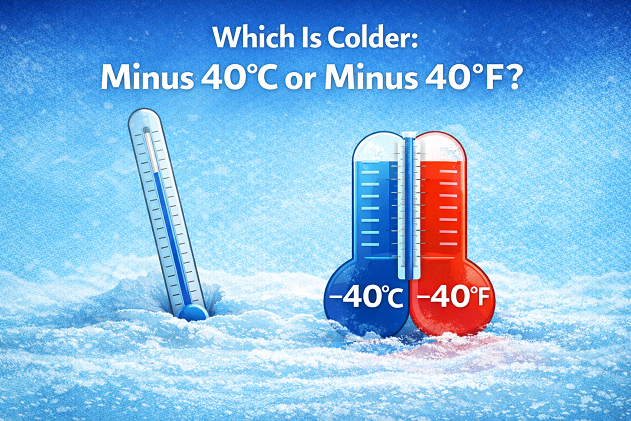
The question “which is colder: minus 40°C or minus 40°F?” has puzzled students, weather enthusiasts, and curious minds for decades. At first glance, the numbers appear to belong to different temperature systems and seem impossible to compare directly. However, science provides a fascinating and unexpected answer.
Temperature measurement plays a critical role in everyday life. Weather forecasts, scientific experiments, industrial processes, aviation safety, and even human survival depend on accurate temperature readings. Because of this importance, temperature scales were developed to ensure consistency and reliability.
In this in-depth article, the mystery behind minus 40 degrees Celsius and minus 40 degrees Fahrenheit will be fully explained. The history of temperature scales will be explored, mathematical relationships will be clarified, and real-world effects of extreme cold will be discussed. By the end of this article, the answer will be understood clearly and confidently.
Understanding Temperature and Its Measurement
Temperature is defined as the measure of the average kinetic energy of particles in a substance. When particles move faster, the temperature is higher. When their movement slows, the temperature is lower. Extreme cold occurs when molecular motion is significantly reduced.
To measure temperature accurately, standardized scales were created. Among many systems, Celsius and Fahrenheit became the most widely used worldwide. Each scale follows its own reference points and mathematical structure.
The Celsius Temperature Scale Explained
The Celsius scale was developed in 1742 by Swedish astronomer Anders Celsius. It was designed to be logical and scientifically practical.
On the Celsius scale:
- Water freezes at 0°C
- Water boils at 100°C
These reference points are based on standard atmospheric pressure. Because of this simplicity, the Celsius scale is widely used in science, medicine, and daily life across most countries.
The scale is divided into 100 equal units between freezing and boiling, making calculations straightforward and intuitive.
The Fahrenheit Temperature Scale Explained
The Fahrenheit scale was introduced in 1724 by Daniel Gabriel Fahrenheit. Unlike Celsius, it was based on several reference points, including a brine solution and average human body temperature.
On the Fahrenheit scale:
- Water freezes at 32°F
- Water boils at 212°F
Although the Fahrenheit scale may seem complex, it allows for finer distinctions in everyday weather conditions. This is one reason it remains popular in the United States.
Which Is Colder: Minus 40°C or Minus 40°F?
The direct and scientifically correct answer is surprising:
This is the only point at which the Celsius and Fahrenheit scales intersect. At no other temperature do the numerical values match.
So, when asked which is colder: minus 40°C or minus 40°F?, the answer is simple:
Neither is colder. They are equal.
Mathematical Proof of the Equality
The relationship between Celsius and Fahrenheit can be expressed using a standard conversion formula:
°F = (°C × 9/5) + 32
To find the temperature where both scales are equal, the values can be set to the same number:
-40 = (C × 9/5) + 32
When this equation is solved, the result is:
C = -40
This confirms that -40°C equals -40°F. This equality exists due to the different zero points and scaling intervals used by each system.
Temperature Comparison Table
| Celsius (°C) | Fahrenheit (°F) | Description |
|---|---|---|
| 0°C | 32°F | Water freezing point |
| -10°C | 14°F | Cold winter day |
| -20°C | -4°F | Extremely cold |
| -30°C | -22°F | Severe winter conditions |
| -40°C | -40°F | Celsius and Fahrenheit meet |
| -50°C | -58°F | Dangerous extreme cold |
This table highlights why minus 40 is unique and memorable.
Why Minus 40 Feels Extremely Cold
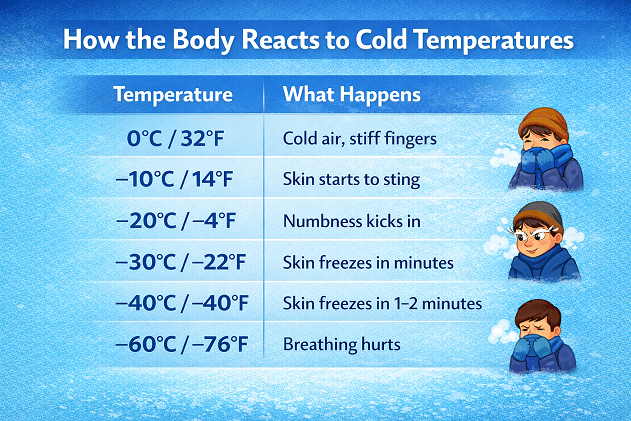
At minus 40 degrees, extreme cold is experienced regardless of the scale used. Heat is lost rapidly from the human body, and exposed skin can freeze in minutes.
At this temperature:
- Frostbite can occur in under five minutes
- Metal surfaces can cause instant skin injury
- Breathing becomes painful
- Mechanical systems may fail
Because of these risks, protective measures are always required in such conditions.
Real-World Locations Where Minus 40 Occurs
Temperatures of minus 40 are rare but not unheard of. They are typically recorded in regions with continental or polar climates.
Common Locations
- Siberia (Russia)
- Northern Canada
- Alaska (USA)
- Antarctica
In these areas, communities are adapted with insulated housing, specialized clothing, and emergency planning.
Historical Significance of the Minus 40 Point
When Celsius and Fahrenheit were created, their inventors did not intend for the scales to intersect at a specific value. The equality at minus 40 is a mathematical coincidence.
Over time, this coincidence became an important teaching tool in physics and meteorology. Students often remember minus 40 as the point where conversions become unnecessary.
Scientific and Educational Importance
In scientific research and weather forecasting, understanding temperature scale relationships is essential. Minus 40 is often used as a reference point because it simplifies communication.
Meteorologists frequently rely on this fact during extreme weather reporting, especially when communicating with international audiences.
Minus 40 Compared to Absolute Zero
Absolute zero is the lowest possible temperature in the universe. At this point, all molecular motion theoretically stops.
- Absolute zero in Celsius: -273.15°C
- Absolute zero in Fahrenheit: -459.67°F
Compared to absolute zero, minus 40 is still relatively warm. However, for human survival, it remains extremely dangerous.
Is Minus 40 the Coldest Temperature on Earth?
No. The coldest naturally recorded temperature on Earth was -89.2°C (-128.6°F) in Antarctica.
However, minus 40 is often remembered because it is the coldest temperature experienced in many inhabited regions.
Practical Applications of Understanding Minus 40
Understanding that minus 40°C equals minus 40°F is useful in many fields:
- Weather forecasting
- Aviation and aerospace
- Engineering and construction
- Military operations
- Outdoor survival training
Clear understanding prevents miscommunication and enhances safety.
Common Myths About Minus 40
Myth 1: Minus 40°F Is Colder Than Minus 40°C
This is incorrect. Both temperatures are identical.
Myth 2: Life Cannot Exist at Minus 40
Life can exist with proper protection and adaptation, although exposure is dangerous.
Frequently Asked Questions (FAQ)
Which is colder: minus 40°C or minus 40°F?
Neither. Minus 40°C and minus 40°F are the same temperature.
Why do Celsius and Fahrenheit meet at minus 40?
They meet because of the mathematical relationship between the two scales.
Is minus 40 common in daily weather?
It is rare but occurs in polar and continental climates.
Can vehicles operate at minus 40?
Yes, but specialized fluids and engine heaters are required.
Is minus 40 colder than a household freezer?
Yes. Most freezers operate around -18°C (0°F).
Final Conclusion
The question “which is colder: minus 40°C or minus 40°F?” has a clear scientific answer. Neither temperature is colder than the other. They are exactly equal.
This unique intersection highlights the fascinating nature of temperature measurement and mathematical relationships. Whether studied in classrooms, used in scientific research, or discussed in weather reports, minus 40 remains one of the most interesting points on the temperature scale.
Understanding this concept improves scientific literacy, prevents confusion, and adds a memorable fact to anyone’s knowledge.