Organisations often say they want to “prove the value” of AI, but that request can hide a difficult truth: many of the benefits are real and meaningful, yet hard to quantify precisely. AI can reduce friction in work, improve the quality of decisions, speed up cycles, and reduce rework. It can also increase capability by making expertise more accessible. These effects show up across many workflows, often in small increments, and they do not always translate neatly into a single ROI figure.
This creates a familiar pattern. Early pilots look promising. Leaders ask for a business case to scale. Teams struggle to quantify benefits, particularly when value comes from improved quality rather than direct cost reduction. Momentum then slows, not because the use case is wrong, but because measurement is not designed for the kind of value AI creates.
Measuring AI value becomes easier when organisations shift their approach. Instead of trying to calculate one perfect number, the goal becomes to build a credible evidence base that links AI use to measurable outcomes and to make that evidence repeatable across use cases. This is less like accounting and more like performance management. You establish baselines, choose the right indicators, run structured comparisons, and track value over time.
This article explores practical ways to measure framework for implementing AI safely when benefits are hard to quantify. The focus is on measurement approaches that are realistic, credible, and useful for decision-making.
Why AI value is often difficult to measure
AI value is hard to quantify for several reasons:
- Benefits are distributed across many tasks rather than concentrated in one place.
- Benefits are incremental, such as saving a few minutes on repeated activities.
- Value is partly qualitative, such as improved judgement, consistency, or reduced cognitive load.
- Workflows change once AI is introduced, making before-and-after comparisons messy.
- Attribution is unclear, especially when improvements are also driven by training, process changes, or technology upgrades.
Measurement fails when organisations try to force AI into a traditional project ROI approach too early, or when they demand precision before the organisation has enough real usage data.
Start by defining the value hypothesis clearly
Every AI use case should have a clear value hypothesis. Not a vague statement like “improve productivity”, but a specific claim about what will change and why. A strong value hypothesis usually includes:
- The workflow being improved and who performs it.
- The pain point being addressed, such as delays, errors, or low consistency.
- The mechanism of improvement, such as faster drafting, better triage, or fewer handoffs.
- The expected measurable outcomes, even if approximate.
- The expected risks or trade-offs, such as increased review time or potential error modes.
Value hypotheses are useful because they guide measurement design. If you do not know what change you expect, you cannot measure it credibly.
Measure value at three levels, not one
AI value can be measured at three levels. Many organisations focus only on one level and miss the others.
- Task level – the impact on a specific activity, such as drafting, summarising, or classification.
- Workflow level – the impact on an end-to-end process, such as case handling, onboarding, or incident resolution.
- Outcome level – the impact on organisational outcomes, such as customer satisfaction, risk reduction, or margin improvement.
Task-level measures are often the easiest to capture early, but they can mislead if they do not translate into workflow improvements. Workflow-level measures are typically more meaningful, but harder to isolate. Outcome-level measures are the most important strategically, but often the hardest to attribute directly to AI.
A practical approach is to measure at all three levels, with different degrees of confidence. You do not need perfect certainty at each level, but you do need a coherent story that links them.
Use baseline sampling rather than trying to measure everything
Measurement becomes achievable when organisations accept sampling. Most workflows are too complex to instrument perfectly. Instead, you can measure a representative sample of work before and after AI is introduced.
Sampling approaches include:
- Time studies on a small set of tasks, repeated across teams.
- Quality scoring on outputs, using agreed rubrics.
- Process metrics for cycle time, backlog, and rework rates.
- User experience surveys focused on specific outcomes, not general sentiment.
The goal is not to capture every benefit. The goal is to capture enough credible evidence to guide scaling decisions and prioritisation.
Measure “time saved” carefully, not naively
Time saved is one of the most common AI value claims. It is also one of the easiest to overstate. If AI saves ten minutes per task, that does not automatically become cost savings. It becomes value only if the time is redeployed to higher-value work or if it reduces staffing needs without damaging service.
To measure time saved credibly:
- Measure the time spent on the task before AI, using sampling.
- Measure the time spent with AI, including review and correction time.
- Track how often the AI output is used versus ignored.
- Assess whether the saved time changes throughput, service levels, or backlog.
Time saved is most meaningful when linked to workflow outcomes, such as faster resolution, increased throughput, or reduced overtime.
Include quality measures, not only efficiency measures
In many use cases, AI value is more about quality than speed. Examples include more consistent documentation, fewer errors, better triage decisions, and more complete information capture. Quality improvements can reduce risk and rework, which may be more valuable than simple time savings.
Quality can be measured through:
- Rubric-based scoring of outputs, such as completeness, clarity, and adherence to standards.
- Error rates and rework rates, such as corrections required downstream.
- Escalation rates and complaint patterns, where relevant.
- Audit findings and control failure patterns, where AI supports compliance workflows.
Quality measures also support trust. If leaders can see evidence that output quality is improving, they are more likely to support scaling.
Track adoption and behavioural signals
AI value cannot appear if people do not use the tool. Adoption metrics are therefore value metrics, particularly early on. However, simple usage counts can be misleading. What matters is meaningful usage within the intended workflow.
Practical adoption measures include:
- Frequency of use in the target workflow, not general experimentation.
- Completion rates for AI-assisted steps, such as drafted responses that are actually sent.
- Patterns of prompt and output correction, which can signal training needs.
- User confidence and validation behaviour, such as whether outputs are reviewed appropriately.
These behavioural signals help organisations understand whether AI is becoming embedded and whether it is being used safely.
Use comparison groups to strengthen credibility
Where benefits are hard to quantify, credibility improves when you use comparison groups. This does not need to be a perfect experiment. It can be a practical comparison between teams, time periods, or workflow segments.
Comparison approaches include:
- Pilot versus control – one team uses the tool while another continues as usual.
- Staggered rollout – introduce AI to different teams in phases and compare outcomes.
- Before and after – compare performance using consistent measures, acknowledging limitations.
- Case mix adjustment – where possible, adjust for complexity differences in work handled.
Even imperfect comparisons can help leadership trust the direction of impact, which is often what is required to make scaling decisions.
Measure risk reduction as value, not just as compliance
AI can introduce risk, but it can also reduce risk. For example, AI can help identify anomalies, enforce consistency in documentation, or surface issues earlier. These benefits can be hard to price, but they matter.
Risk reduction can be measured through indicators such as:
- Reduced error rates in high-volume processes.
- Fewer policy deviations in documented workflows.
- Improved detection of issues, such as earlier escalation of customer complaints.
- Reduced control failures or repeat audit findings where AI supports evidence handling.
The key is to treat these as operational value indicators, not just “risk team metrics”. Reduced rework, fewer incidents, and improved resilience have real organisational value.
Build a value dashboard that is simple and repeatable
AI programmes often fail to scale because each use case uses different measures and different reporting formats. This makes value hard to compare across the portfolio, and it creates uncertainty for leadership.
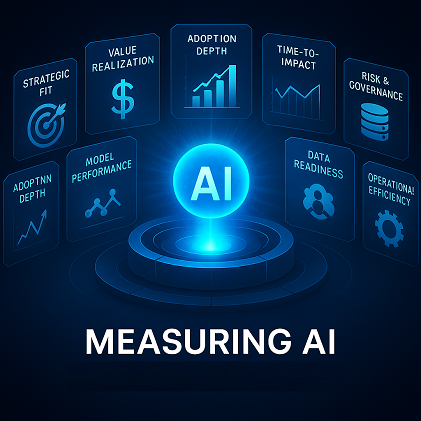
A simple, repeatable value dashboard can include:
- Adoption – how much the tool is used in the intended workflow.
- Efficiency – time saved and throughput changes, with clear assumptions.
- Quality – error rates, rework, and rubric scoring.
- Risk – incidents, near misses, and compliance indicators.
- User experience – targeted feedback on usefulness and trust.
The dashboard should be consistent across use cases. The measures can vary slightly, but the structure should remain stable. This allows leadership to see which use cases deliver value and which require improvement or retirement.
Accept that some value is enabling value
Not all AI value is immediate. Some value is enabling. For example, improving data quality, building governance processes, and training staff may not deliver immediate ROI, but they enable future AI use cases to scale safely. Organisations that treat enabling work as “overhead” often stall because they never build the foundations required for sustained value.
Enabling value can be measured through capability indicators such as:
- Time to approve and deploy new use cases, indicating governance usability.
- Coverage of training and adoption of safe use practices.
- Reduction in shadow tool usage due to clear approved pathways.
- Improved data quality metrics for key datasets.
These measures help leadership see that foundation work is not wasted. It is what makes later value possible.
A practical reference point for framing measurement within broader AI programmes
For organisations trying to link measurement to wider AI adoption choices across governance, capability, and delivery, it can help to work from a broad baseline view of what enterprise AI work typically involves. This page provides a high-level view of enterprise AI work across common themes that influence how value is created and sustained.
Credible measurement is about evidence, not perfection
Measuring AI value is difficult when benefits are incremental, distributed, and partly qualitative. The solution is not to chase a perfect ROI number. The solution is to build a credible evidence base. Define a clear value hypothesis. Measure at task, workflow, and outcome levels. Use sampling and comparison groups. Track quality and risk as well as speed. Build a simple, repeatable dashboard that supports portfolio decisions.
When measurement is designed this way, it becomes a management tool rather than a barrier. It helps leaders decide what to scale, what to improve, and what to stop. It also helps teams focus on the use cases that deliver genuine, sustained value, even when that value cannot be captured in a single headline number.